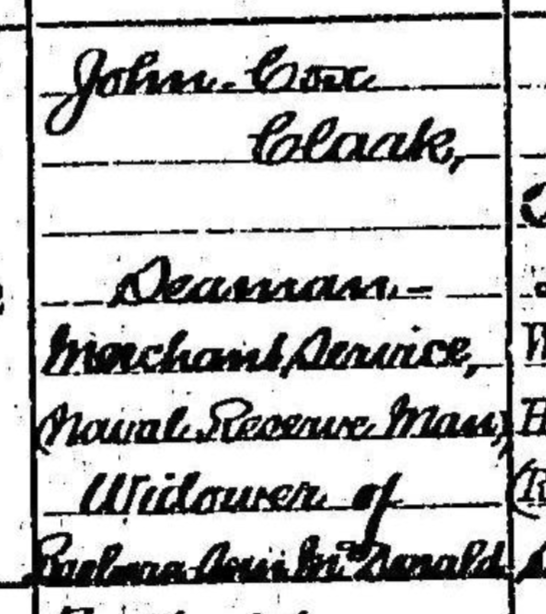
My great grandfather’s name was recorded as John Cox Clark when his son, Thomas, registered his death in 1912, which puzzled me as Cox is not a family name and it doesn’t appear in any other records.
I think it was probably a tee-name, or nickname, traditionally used by the coastal communities of Aberdeenshire to distinguish between families who shared the same surname.
Tee-names generally picked up on a distinguishing feature, such as stature, hair colour or occupation, and in this case Cox seems likely to relate to John’s working life: although he was born the son of a crofter, he became a Greenland whaler.
For over 100 years, Peterhead ships set out each spring for the Arctic waters, returning in August laden with valuable whale and seal blubber, and by the mid 19th century the town had become Britain’s premier whaling port. The prosperity this generated lured many young men away from poorly paid farm work, and a seaman’s ticket dated 17 April 1856 shows that John Clark, aged 18, was among them when he was apprenticed aboard the Xanthus, a ship owned by the Buchan Seal and Whale Fishing Company.
John’s occupation is described as a seaman when he marries Barbara Ann McDonald in Peterhead in 1862, and he is missing from both the 1861 and 1871 census listings, which suggests he was away at sea. Sadly, few crew lists from the whaling fleet survive, but in addition to the 1856 seaman’s ticket, my great grandfather’s Royal Naval Reserve record covering 1872-1876 survives in The National Archives at Kew.
The Naval Reserve was first established in 1859 and was made up of professional seamen from the merchant navy who could be called upon during times of war to serve in the regular Royal Navy. Only a selection of these service records survive, with each covering a five year period – John’s record reveals that he had first joined the Reserve in 1861 and that he served as a harpooner sailing to Greenland aboard the Active in 1872 – 1874, on the Windward in 1875, and the Mazinthian in 1876.
There is also a crew list that includes John Clark, aged 42 and from Peterhead, working as a harpooner sailing aboard the whaling ship “Victor” from Dundee in 1879 and 1880. Clearly he had risen through the ranks of the ship’s crew during his long and arduous career at sea as the harpooner was the most senior, and highest paid, crew member below the officers.
His presence at home for the 1881 census, alongside the records from Dundee, reveals that by this time the Peterhead whaling industry was rapidly declining, not least because the quarry it depended on had been hunted to the verge of extinction. This must have been an immensely challenging time for the family as the trade that John relied on for his income no longer existed and, as a man already in his 50s, his options for alternative employment must have been limited in a town where so many others found themselves in the same situation.
In 1889, the Clarks left their home in Peterhead with their five youngest children and moved to Maryhill in Glasgow, where John lived out the rest of his life. Although he was still describing himself as a merchant seaman when my grandmother was born in 1890, by the time his wife died in 1891 John Cox Clark is working as a gasworks labourer.
 Sleuthing Notes