
When I look at all the places my ancestors have called home, one address stands out: Harley Street in Portsmouth, where four generations of the Maitland family lived for almost 80 years.
The street was in the Landport area, which now forms the commercial centre of the city but was originally a residential neighbourhood housing workers from the nearby dockyard. Harley Street no longer exists, but my father lived there as a child and recalled a brick-built, 3 bedroom terraced house with a garden and cellars, typical of the streets in that part of Portsmouth. He drew this map for me from memory many years ago:
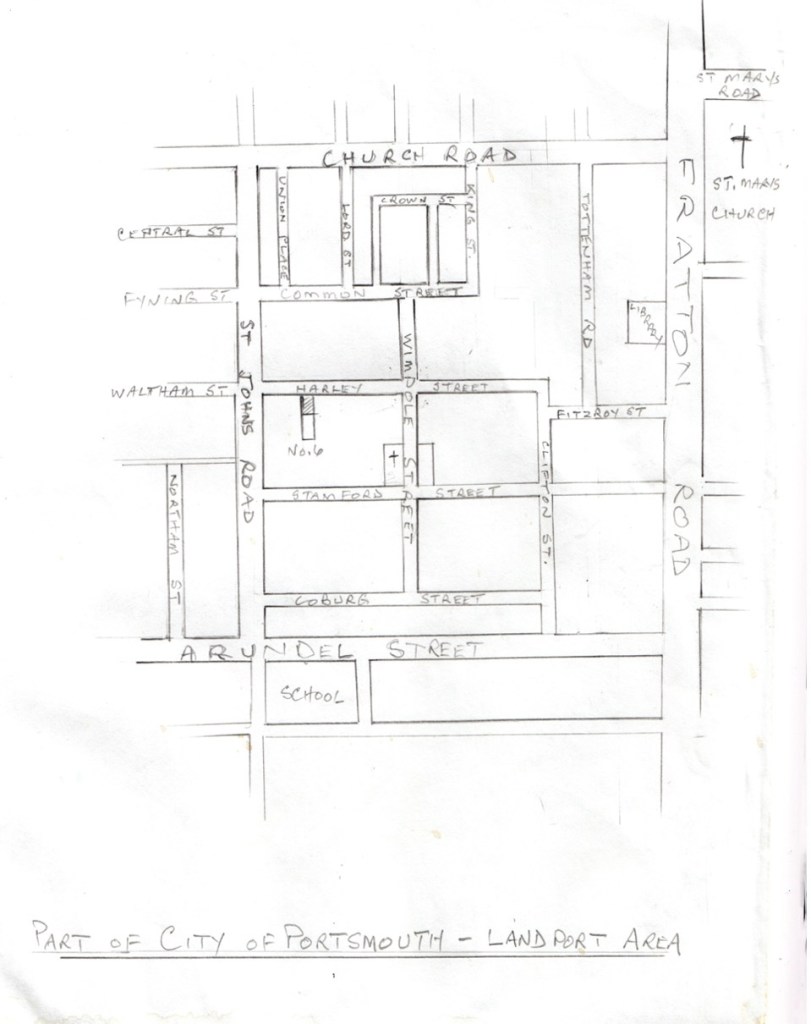
The earliest reference I have found dates from 25 November 1865, when the death certificate for my great great grandfather, James Maitland, records his address as No. 33 Harley Street. In an earlier post [see Surprise], I revealed that he had moved to Portsmouth from Blandford Forum in Dorset at some point between 1851 – 1861, together with his four children: James, George (my great grandfather), John and Elizabeth. This would not have been an unusual move as migration to the rapidly growing English cities was by then in full flow, and it is easy to imagine the tempting prospect that the burgeoning population of Portsmouth must have offered to a family of provincial tailors.
It is likely that James Maitland’s eldest son, also named James, was actually the first to make the move as he does not appear in the 1851 census for Blandford, when he would have been 22 years old. I cannot find him in the census for Portsmouth, but he married Mary Jane Knight in St Mary’s Church, Portsea on 28 May 18551, and by 1861 had set up home at 7 Portsea View, where he is living with his wife and three other family members: his father, his brother George and a cousin, Mary Ann. The three men are all tailors, Mary Jane is a tailoress and Mary Ann, a dressmaker.
The rest of the Maitland family is also living in Portsmouth by this date: in 1861, John is a railway porter living with his wife, Jane Fly, and their baby daughter in Lucknow Street, and Elizabeth is a domestic servant working for two elderly sisters in King Street.
Elizabeth was to die three years later at the age of just 23, shortly after her marriage to William Prewer and the birth of their first child, but 1871 finds her three brothers all residing in Harley Street:
No. 6 – George, an unmarried tailor, is living with his aunt, Ann Maitland, and her daughter Mary Ann. Ann Maitland was my great great grandfather’s sister – she had never married and had retired to live in Portsmouth after a lifetime working as a domestic servant. The census records Ann as the wife of an unnamed head of household, presumably to mask the fact that her daughter was illegitimate.
No. 33 – James is living with his second wife, Eliza Foulsham, who he married after the death of Mary Jane Knight in 1866. He is described as a tailor and beer retailer. They have no children.
No. 50 – John is an upholsterer’s porter who is living with his wife, Jane Fly. They now have three young daughters.
The houses in Harley Street would have been newly built when the Maitlands moved in as they were constructed around 1860. Their neighbours in 1871 are mostly skilled manual workers such as joiners, blacksmiths and shipwrights who would have worked in the dockyard, but there are also retired seamen, bootmakers, porters and a butcher. Clearly a working-class area, but the living conditions would have been better than in many parts of the city, and none of the households have had to sublet or take in lodgers to make ends meet, which suggests they were relatively prosperous.
By 1881, John has moved elsewhere in the city, but James and George are still living in Harley Street. George is now married to his cousin, Emily Dowding, and they have a one year old son, William – my grandfather, Frederick Maitland, is born at No. 6 in 1886.
James and his wife, Eliza, have moved to Sidcup in Kent when the 1891 census is taken, but George continued to live at the same house in Harley Street until his death in 1913, when it was taken on by his widow, Emily. In 1921 she is living at No. 6 with her unmarried children, Albert and Ellen, and after the death of my grandmother, Flora Clark, in 1930 they are joined by my grandfather, Frederick, and his two young sons: Roy and Norman (my father). Emily died a year later, and it then fell to her daughter, Ellen, to keep house for her brother and nephews – she never married and lived with my widowed grandfather until his death in 1951.
The Maitland family’s long association with Harley Street was brought to an abrupt end by a German Luftwaffe bomb on the afternoon of 24 August 1940. The dockyard and numerous other military installations made Portsmouth a prime target during the Blitz and the city suffered 67 air raids between July 1940 and May 1944 – 930 people were killed, almost 3,000 injured and it is estimated that around 20% of the city’s 63,000 homes were destroyed or badly damaged. No. 6 Harley Street remained standing but was deemed to be in a dangerous condition, so the family had to move out – my father recalled a large crack in the façade that ran from the roof to the cellar.
The remains of Harley Street were finally demolished in 1969 as part of the large scale post-war re-development of the city.
1 as usual there is a mystery to be solved – on 27 December 1852, a 22 year-old tailor named James Maitland married Amelia Mary Ann Simmons at St Mary’s Church in Portsea. His father is recorded as James Maitland, who is also a tailor, and the groom’s signature suggests that he is the same man who married Mary Jane Knight in the same church three years later, when he claimed to be a bachelor. I can find no trace of any further records relating to Amelia.
 Sleuthing Notes