I had my DNA tested in March 2023, and currently have the results loaded on four sites: Ancestry, My Heritage, 23andme, and FamilyTree DNA. As well as discovering where my ancestors came from, I hoped that DNA would enable me to verify my paper-based tree, break through some brick walls, and perhaps find some of my elusive Scottish relations.
Recently, there has been a string of news stories reporting the sometimes devastating impact of receiving unexpected test results, and I certainly held my breath when I opened mine for the first time. Thankfully, there was no bombshell, and I have now identified DNA matches who descend from all sixteen of my great great grandparents as well as many of their parents, which means that my genes appear to match the paper records.
One of the great advantages of DNA testing is the ability to break through brick walls by building clusters of shared matches and triangulating their relationships to one another. I will cover some specific cases in later blog posts, but I have successfully used the technique to resolve several situations where there was more than one candidate in the frame, including my 2x great grandmother, Elizabeth Welch, and my 3x great grandfather, Matthias Dowding.
In common with most people who take a DNA test, I was curious to know which geographical regions my family originally came from. The testing companies use carefully selected reference panels, whose families are known to have lived in a particular place for many generations, to estimate where ancestors are likely to have been living around 500 – 1,000 years ago. The results are sometimes dismissed as hopelessly inaccurate since they are regularly updated as the knowledge pool grows and analysis becomes more refined, and it doesn’t help that each company uses slightly different descriptions or levels of detail in their maps.
I’m happy to accept that this element of DNA testing is currently a work in progress, and for me it has again yielded no surprises since my distant ancestors apparently all hail from northwestern Europe, and mostly from the parts of the UK where they were still living in the 18th century when I can begin to trace them through written records.
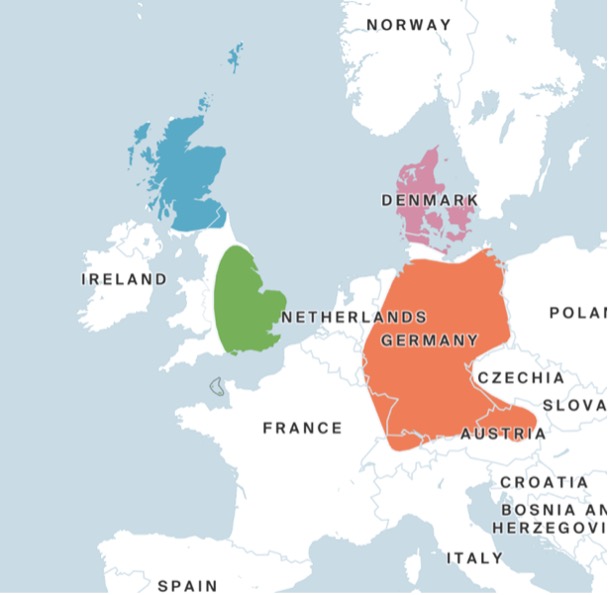
This screenshot was taken from the Ancestry site, which also provides a breakdown suggesting that 46% of my DNA originates from England and 40% from Scotland – as might be expected from my tree, the Scottish DNA was inherited from my father whilst most of the English came from my mother’s side.
Almost all of the 14% that Ancestry links to Denmark and Germanic Europe is inherited from my mother and can be explained by Anglo Saxon migration to East Anglia – most people with significant amounts of English DNA will find a similar pattern in their mix. My Heritage and 23andMe suggest that a higher proportion comes from continental Europe and they also identify some additional areas such as Breton and Dutch, but the overall pattern is broadly similar and again it fits the expected pattern of population movement within northwestern Europe over the past 1,000 years.
Perhaps the most intriguing result is the 3.6% of Spanish and Portuguese DNA that 23andMe claims to have found as my grandmother used to proudly tell me that a Spanish lady had married into her family at some point. I have never found any trace of her, but perhaps another family legend might just be true. Somewhat more distantly, this site also identifies Neanderthal DNA markers – they account for less than 2% of mine, but I am apparently more Neanderthal than 83% of testers !
In terms of individual DNA matches, Ancestry currently lists almost 24,000 people and My Heritage has around 11,000. Many of them are likely to be false matches as the DNA segments that match are so small that they could be the result of chance rather than inheritance, but I have so far been able to place almost 300 previously unknown relations in my tree, the closest a 1st cousin once removed and the most distant a 6th cousin.
To my delight, amongst them are several of the descendants from my Scottish grandmother’s siblings that I set out to find and, thanks to DNA testing, I was finally able to meet two second cousins in Aberdeenshire last year.
 Sleuthing Notes