In May 1917, my great grandmother, Ruth Pursglove, wrote some poignant words in a letter she sent to my grandmother:
“Poor Mrs Norfolk, what must her grief be – I picture myself in her place if I lost both my boys”
Sadly, within just a few months she was to experience exactly how it felt as her two eldest sons, Oscar and Jack Howe, were among the 7,000 young men from Suffolk killed in action during the First World War.
Oscar Howe

Oscar was born on 17 February 1895 in Great Hallingbury, Essex. He was my grandmother’s elder brother and she described him as a very gentle, country boy who loved nature and worked as a gardener.
War was declared on 4 August 1914 and by 9 September Oscar had enlisted in response to Lord Kitchener’s appeal for 100,000 men to sign up. These young men would clearly have had absolutely no idea of what they were to face, and it was in any case confidently expected that it would “all be over by Christmas”. According to my grandmother, the village parson had tried to talk Oscar out of going as he felt he was not made for fighting.
Clearly the army did not agree as he was assigned to the 8th Battalion of the Suffolk regiment as Private 14284 and sent to France in July 1915. His first few months there seem to have been spent relatively quietly in training, trench digging or small scale raids against the enemy, but all this was to change on 1 July 1916 with the commencement of the infamous battle of the Somme which resulted in more than 1 million casualties, including 420,000 British soldiers.
Oscar survived the battle, and his Battalion was then involved in a long round of smaller scale skirmishes in France and Flanders, although not all of their time was spent at the front as they had periods of rest, training in reserve and waiting for orders. Oscar also occasionally had leave, which is recorded in his mother’s letters, including a visit home in January 1917 when he spent time with his family and with his sweetheart, Gertrude “Honey” Purdy.
This proved to be the last time they were to see him as on 31 July 1917 Oscar died from wounds sustained on the first day of the Third Battle of Ypres, which was an ill-fated allied plan to push through the German lines to the Belgian coast. Now commonly known as Passchendaele, Oscar was one of around 300,000 British soldiers who lost their lives during the battle.
He is buried in the Commonwealth War Graves cemetery at Dikkebus near Ypres in Belgium, alongside 1,093 other Commonwealth casualties who died between July and November 1917, most of them gunners from nearby artillery positions.
John Pursglove Howe
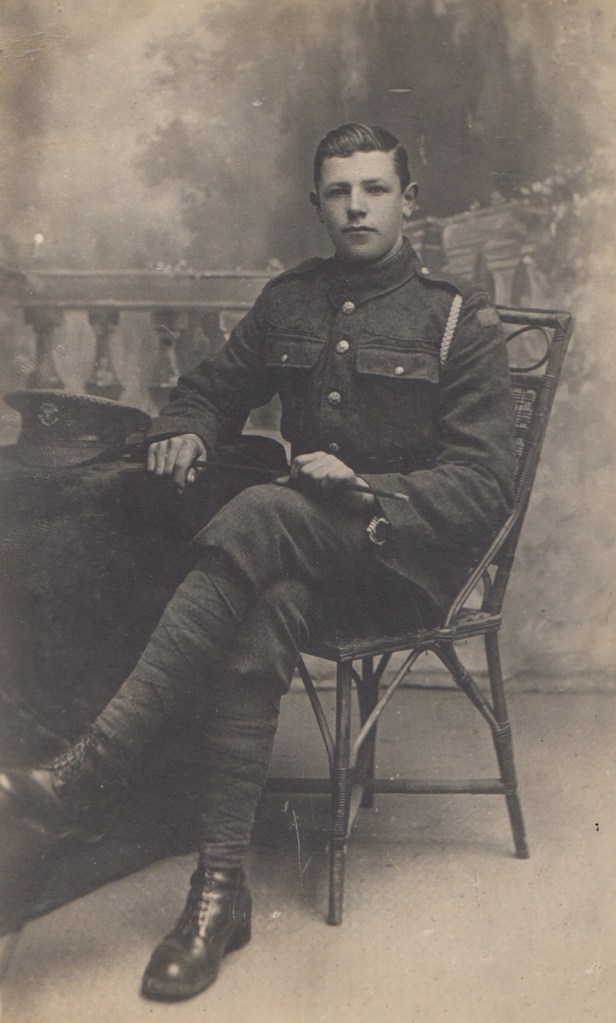
Oscar’s younger brother, who was always known as Jack, was born on 11 September 1898 in Great Hallingbury. From the letters written by his mother we get a picture of a lively boy, fond of practical jokes, who seems to have inherited the Howe love for country pursuits as by May 1914 she reports that he is joining his gamekeeper father on shoots. She also mentions that he has been working as a gardener at Thorington Hall, where his father was employed, and that he was regularly involved in “rabbiting”, which was often the first step to becoming a gamekeeper.
From his photograph it is clear that Jack was a handsome boy, and he was certainly popular with the girls – on 25 February 1917 he wrote to his sister “who do you think I heard from this morning ? Midge Purdy, she said she would like to write to me. Let ‘em all come, it is about 100 I have got to write to. I shall have to pick the best out and leave the others, what do you think ?”.
Jack enlisted in January 1917 when he was just 18 years old. As he could not be sent to the front until he was 19, he first joined the Somerset Training Regiment and completed his training in Dorset and Wiltshire before being assigned to the 11th Battalion Suffolk Regiment as Private 41975.
His war was very different to his brother’s as he would have gone to France in the autumn of 1917 in the full knowledge of what he faced, just a few weeks after his elder brother was killed. There are hints in Ruth Howe’s letters that, like many young men in a similar position, he was fired by anger and determined to personally avenge his sibling’s death. In April 1918, she wrote to my grandmother with the news that Jack had been “in a terrible battle” and had written to tell her that he’d “done enough to pay for poor Oscar’s death”.
The years of trench warfare stalemate and long futile battles were by then coming to an end and the Germans had unleashed a final massive offensive in an attempt to end it. Initially this was highly successful, but ultimately they could not sustain the attack and within a few months the Great War was to all intents and purposes over.
The Armistice came too late for Jack as on 16 May 1918 Ruth Howe wrote to tell my grandmother that he was reported as missing in action. His family must have hoped that he might return home a prisoner of war, but it would be almost a year after he went missing that news would finally reach his mother of his fate. She was told by Lance Corporal Sallybrass, who was with Jack when he was wounded, that they were “mowing Germans down with a Lewis gun” lying along a road north of Armentieres when Jack was shot between 3 and 4 on the afternoon of 9 April. Poor Jack, the corporal said, “never felt his death as he never stirred” – I hope that this is true, though unsurprisingly it is the story that many grieving mothers were told at the time.
More than half a million WWI casualties have no known grave, and Jack is amongst them – according to Corporal Sallybrass, he was buried in a temporary cemetery near where he fell that was later lost during a German advance. His name is engraved on the Ploegsteert Memorial near Ypres in Belgium, which lists more than 11,000 servicemen from the UK and South African forces who died in the area and have no identified resting place.
Wherever Jack lies, the Howe brothers must now rest in Flanders within just a few miles of one another. They are commemorated on a memorial tablet in St Peter’s Church, Thorington in Suffolk along with four other men: 2nd Lieut. Alfred Bence Trower, Major Edward Bence Trower MC, Josiah Flatt and William F Smith.
 Sleuthing Notes