I have a number of interesting surnames in my tree, but my favourite is Pursglove. Somewhat disappointingly, it seems that it has nothing whatsoever to do with either purses or gloves as the consensus is that it is derived from the hamlet of Purslow in Shropshire.
This distinctive name can be traced back through my maternal great grandmother, Ruth Pursglove, to a family who were living in Derbyshire in the early 18th century: John Pursglove and his wife Rebecca had my 6x great grandfather, William, baptised in South Wingfield on 1 July 1703, and my ancestors are recorded there for the next two generations.
However, Ruth Pursgloves’s grandfather, my 3x great grandfather Thomas Pursglove, appears to have enjoyed a rather more adventurous life. Although he was baptised in Ashover, Derbyshire on 3 November 1793, the next record I have for him is his marriage to Susannah Wheeler on 24 March 1823, which took place 125 miles away in Wyddial, Hertfordshire. This would have been an unusual move at a time when people tended to stay close to the place they were born, and strangers were generally not welcomed because the parishioners in a new place did not want to become responsible for supporting newcomers if they fell on hard times.
From 1601 until 1834, the Poor Law required each parish in England to support their paupers using money raised through a system of Poor Rates, which was administered by an elected Overseer of the Poor. The 1662 Settlement Law enabled the Overseer to seek the removal of an incomer from their parish if they didn’t meet a number of conditions, including the annual payment of at least £10 in rent.
An alternative was to produce a Settlement Certificate which effectively indemnified the new place of residence as it meant that the holder would be accepted back by another parish in the event that they needed support. Establishing the place of settlement was thus very important for a family, as well as for the Overseer and his parishioners.
This could prove to be a challenging process and if there was any doubt an examination would take place before the local Justices of the Peace. The rules were complex as settlement was not related to place of birth – there were several ways to gain it, but the most common was through living in a parish while serving an employer for at least a year. An individual who moved from place to place for work could thus acquire a whole series of settlement certificates over their lifetime. Wives automatically acquired the settlement of their husband, as did their children.
On 4 November 1830, Thomas Pursglove fell foul of this system when the Justices of the Peace for Hertfordshire approved a removal order requested by the Overseer for the Parish of Wyddial. This stated that Thomas, his wife Susannah and their three children had come to inhabit in the parish not having gained legal settlement there nor having produced any certificate acknowledging them to be settled elsewhere. The Overseer declared that their true place of settlement was Scarcliff in Derbyshire and the Justices ordered the family to be sent back there.
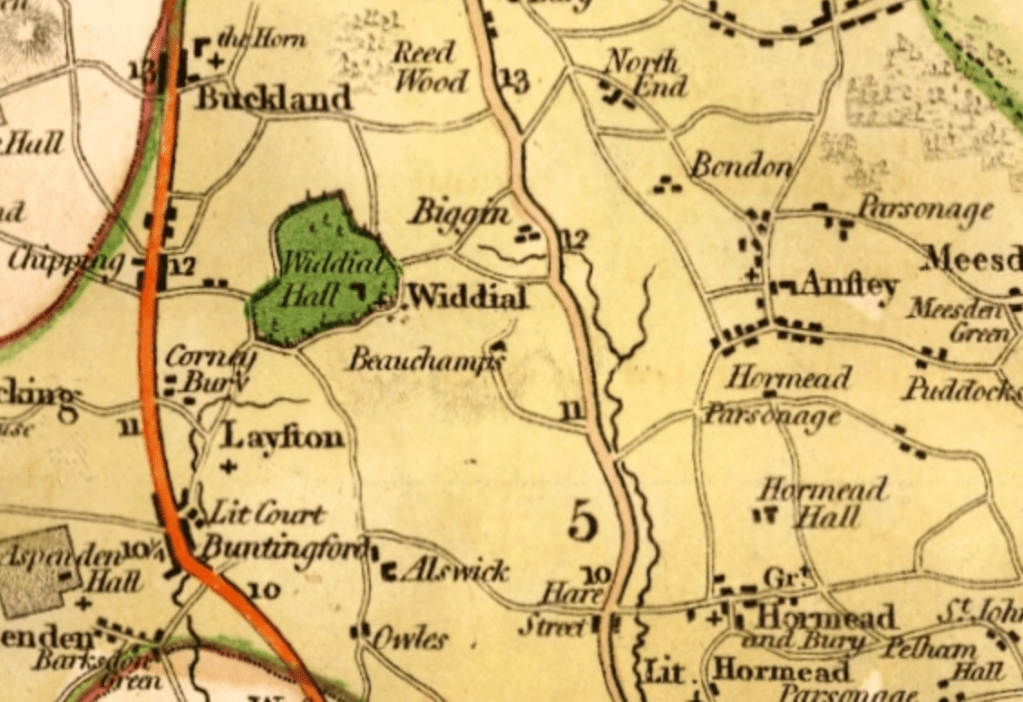
Extract from 1808 Map of Hertfordshire
No explanation for this decision survives, but it seems harsh as Thomas had lived, and presumably worked, in Wyddial for at least five years by then and all three of the children listed in the removal order were baptised there: George (1823, my great great grandfather), Sarah (1826) and Ellen (1828). Unsurprisingly, Scarcliff appealed against the removal order and on 3 January 1831 it was quashed by the Quarter Session in Hertford.
Thomas and Susannah continued to live in Wyddial for the rest of their lives and had three further children baptised there: John (1831), Emma (1834) and Stephen (1838). Thomas is working as an agricultural labourer in the 1841 and 1851 census records, and in 1861 he is described as “formerly ag lab” living at Hall Farm, which suggests that he had been employed on the Wyddial Hall Estate.
Thomas died at the age of 71 in 1864 and his wife Susannah in 1883, aged 86. The mystery of how and why a man born in Derbyshire in 1793 ended up in Hertfordshire remains unsolved.
 Sleuthing Notes