In addition to the master tree that records my direct ancestors and their descendants, I have a number of research trees which I use to explore the unlinked family clusters of DNA matches that every genealogist will eventually end up with.
These clusters are formed of numerous DNA matches who all descend from the same family, but who cannot be linked into a specific line in your own tree. There may be several reasons for this – perhaps the common ancestor is so distant that they are beyond the reach of documentary evidence, which tends to peter out in the mid-18th century, or if more recent, there is a chance that somewhere the written records do not accurately reflect a biological parent.
Sometimes, it is eventually possible to form a hypothesis, as for example in the case that I described in Family Secret, but in most instances it is highly unlikely that the mystery can ever be resolved. So why research these clusters ? Apart from the ever present lure of simple curiosity, they can suggest new lines of inquiry, provide an insight into more distant family origins and add useful context in the form of social history. In a nutshell, I see this as my family history playtime since I never know where the research will take me ….
For example, my largest unlinked cluster contains almost 90 DNA matches who all have connections to Newfoundland and Labrador, particularly to Gooseberry Island in Bonavista Bay. Initially I assumed that the link would be through Scottish emigrants to Canada, but as I looked though the matches’ trees, I instead found multiple lines stretching back to families who were living in Dorset in the 18th century, particularly the Sweetapples from Hinton Martell and the Fudges from Sturminster Newton. I cannot currently tie any of them to the families in my tree, but given the geographical location, a connection to the Dorset ancestors of my paternal grandfather seems likely.
With a little research, I discovered the longstanding tradition of seasonal migration from England’s West Country to the rich cod fishing grounds of the Grand Banks. For almost four centuries, hundreds of small wooden ships would set off Devon and Dorset in the spring, returning in the autumn via Mediterranean countries such as Spain and Portugal, where they sold their valuable cargo of salted cod. To begin with, temporary cabins were erected each year and the crew returned home at the end of each season but, in the 18th century permanent settlements were established and increasing numbers began to overwinter, which encouraged family members, merchants and craftsmen to join the fishermen making their home in Newfoundland.
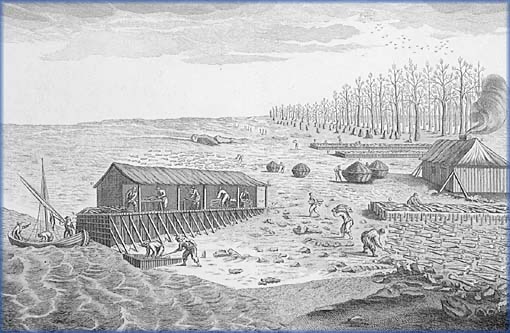
Station for preparing and drying cod by Duhamel du Monceau, 1793
The wealthy shipmasters lived in coastal town such as Poole, Weymouth and Lyme Regis but the men and boys they relied upon for crew would be recruited each year from towns and villages in the surrounding countryside. I have no way of knowing whether any of my direct ancestors were among them, but wider family members certainly were and given the number of DNA matches involved, it is possible that more than one common ancestor is involved.
Other unlinked family clusters that I have established include: multiple families from the fishing communities of Pittulie, Inverallochy and St Combs in Aberdeenshire; the many descendants of Samson Shave and Mary Shepherd who lived in Winterbourne Whitchurch, Dorset in the early 18th century; and two mid-19th century families in Ontario who might one day provide evidence that my great great grandfather, William Clark, established a second family there after he left Aberdeenshire (Brick Wall and Fan Club).
 Sleuthing Notes