When I started researching ancestors who lived in rural Suffolk in the late 19th century, I soon noticed that young men were quite often missing from census records for the places where I would expect them to be.
For example, my great grandparents, Samuel Cullingford and Esther Page, were married in Wantisden on 29 July 1890 but when the 1891 census was taken a few months later, Esther is living with her in-laws in nearby Butley and there is no sign of Samuel. Thanks to his distinctive surname and birthplace, it proved relatively easy to track him down, and I discovered that he was a so-called “Suffolk Jim” working as a maltster 150 miles away in Burton-on-Trent, Staffordshire.
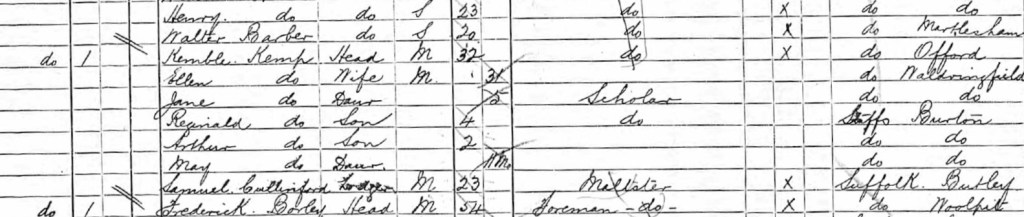
By the end of the 19th century, Burton-on-Trent was home to the most extensive beer breweries in the world with over half of the town’s working population employed by the industry. During the winter months, they would be joined by hundreds of young men in a long-established seasonal migration from farms in Suffolk and Norfolk. These men would have been laid off once the harvest was done and, by following the barley that they had helped to grow to the breweries of Staffordshire, they found work in the malthouses which conveniently required large numbers of workers at precisely the time when agriculture did not.
Malting is a crucial part of the traditional brewing process and involves steeping, germinating and drying grain to convert starches into the sugars required for the fermentation. In the 19th century, this was a highly labour-intensive process as the grain was spread thickly over the floor of the malthouse and had to be turned regularly with shovels and wooden rakes. Working conditions were unpleasantly hot and humid, and as the highly physical manual process required great strength and endurance, young agricultural workers made ideal recruits.
The census only provides a brief snapshot of this seasonal migration, but it is likely that Samuel would have worked in the Staffordshire malthouses for several years as brewery agents would seek out good employees from previous years. He was not the only member of his family to become a Suffolk Jim as his younger brother, George Cullingford, and brother-in-law, Henry Page, are also recorded as maltsters working in Staffordshire in 1891.
Unlike my great grandfather, who returned to his wife in Suffolk and found employment as a warrener on the Wantisden Hall estate, both George Cullingford and Henry Page married local girls in Burton on Trent and continued to work in the brewing industry. George lived in Staffordshire for the rest of his life, but Henry eventually returned to Butley with his family to work as a horseman at Valley Farm after his father took on the tenancy.
 Sleuthing Notes
Similar work programs existed here in the US. I found my 2x great-grandfather (a farmer) in the 1850 census working as a ‘sawyer’ in a lumbering camp. Although, I’d say working in a brewery sounds more appealing to me. Thanks for sharing!
LikeLike
Thank you for your comment – I really enjoy being able to link my ancestors to social history in this way and love never knowing what I will find myself researching next.
LikeLike