My great grandfather, Walter Henry Howe, and his father, John Howe, both feature regularly in newspaper reports of court hearings, but thankfully as witnesses rather than in the dock as they were both gamekeepers and the cases involve poachers.
The gamekeeper’s role was to manage the wildlife on their employer’s estate to ensure that there was sufficient to provide good hunting, and to act as a guide for those pursuing it. It is one of the oldest professions as it dates back to the protection of deer in royal hunting forests in medieval times, and the gamekeeper occupied an elite position in the village hierarchy, sitting below the squire and rector but above the doctor and schoolmaster.
Historically it was an occupation that passed down from father to son and this is certainly the case with the Howes – John Howe’s father and grandfather were also both gamekeepers, as were all six of his brothers and his four sons.
John was born in Whepstead, Suffolk in 1843 but by 1871 he had moved to Oxfordshire where he married Sophia Grant. His obituary in the Oxfordshire weekly news from 1922 reveals that for 44 years he was the head gamekeeper at the grand Bletchingdon Park estate of Arthur Annesley, 11th Viscount of Valentia, as well as providing some intriguing details of his working life. He was apparently “a noted trainer of retrievers and spaniels” and “one of the best shots in the Midlands” although the job was not without its hazards as during a shoot 8 years previously he had “received almost a full [shotgun] charge” with the result that around 30 pellets remained lodged in his body – he remarked that this added considerably to his weight.
The photograph below was taken around 1915 and shows John with his wife, Sophia, surrounded by members of their family and staff from the estate.

My great grandfather, Walter Henry Howe, was born in Whitecross Green, Oxfordshire in 1873 and was the eldest of John and Sophia’s eight children. In contrast to his father’s settled life in Bletchingdon, Walter moved jobs frequently. Although this was not unusual since estate owners generally preferred to avoid their keepers putting down the sort of roots that might lead them to turn a blind eye to poaching, his wife’s letters to my grandmother suggest that he was not always the easiest of men to get on with and that he regularly fell out with other staff on the estate where he worked.
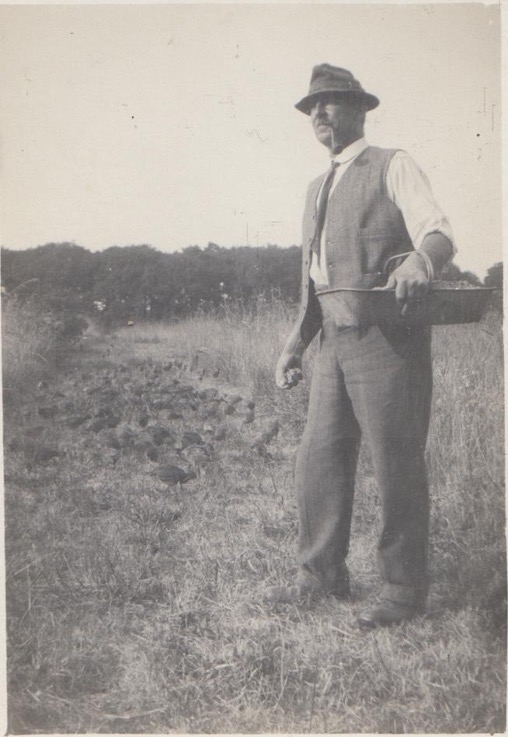
Walter Henry Howe feeding his pheasant chicks
Census records, the birth places of his children and the newspaper reports have enabled me to piece together a rough timeline for his working life:
1895 – 1898 Great Halligbury, Essex – gamekeeper, estate not recorded but probably Hallingbury Place owned by John Archer Houblon, magistrate and deputy lieutenant of the county.
1899 – 1904 Painters, Saffron Walden, Essex – gamekeeper to Lionel Drummond Gosling, retired banker and farmer.
1905 – 1909 Berechurch Hall, Essex – gamekeeper to Thomas Hetherington, gentleman landowner.
1910 – 1913 Langham Hall, Essex – gamekeeper to William Nocton, solicitor and farmer.
1914 – 1919 Thorrington Hall, Suffolk – head gamekeeper to Guy Bence-Lambert, retired Colonel.
1920 – c 1928 The Rookery, Yoxford, Suffolk – head gamekeeper to Sir Herbert Hambling, deputy chair of Barclays Bank.
After WWI work became scarce for gamekeepers as the large estates that had traditionally provided them with employment fell into decline and were broken up – Hallingbury Place, Berechurch Hall and Thorrington Hall were all demolished during the early 20th century.
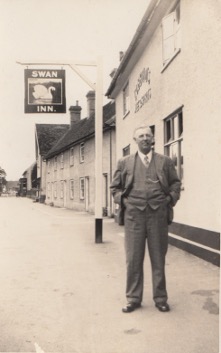
After he left The Rookery, Walter became a landlord, taking on the tenancy of the 16th century Swan Inn in Peasenhall, Suffolk – he is pictured below posing outside the pub. Although Walter’s son Dennis worked as a gamekeeper for a while in the 1930s, the Howe gamekeeping dynasty had effectively reached its end.
In 1933, Walter was left a widower when his wife, Ruth Pursglove, died after a short illness and just a few months later he shocked his family by remarrying – his new wife was spinster Gertrude Purdy who had been engaged to his eldest son, Oscar Howe, when he was killed in action during WWI. Although she was 22 years his junior, Gertrude pre-deceased him in 1857. Walter Howe died in Peasenhall in 1960 at the age of 87.
 Sleuthing Notes