My Suffolk ancestors once worked with an animal that is now rarer than the Giant Panda – the Suffolk Punch horse. Bred as a heavy draught horse, in the 19th century there would have been several thousand at work on farms in East Anglia, but today there are fewer than 500 left in the UK with just 75 breeding mares, making it a critically endangered breed.

Plate showing Suffolk Punch from “New Book of the Horse” published in 1910
Suffolk Punches are always chestnut in colour and are renowned for their power, stamina and docility. Punch is an old English word for a short stout person and was given to the Suffolks because they are smaller and more massively built than other heavy horse breeds.
Although the breed is believed to have originated in the early 16th century, modern horses are generally traced back to one stallion, Thomas Crisp’s Horse of Ufford, foaled in 1768. My 4x great grandfather was Robert Crisp who was born around 1763 and raised his family in Campsea Ash which is just 4.5 miles from Ufford, but sadly so far I have not been able to link him to Thomas’s family.
The part of south eastern Suffolk where my ancestors lived and worked was famous for the breeding of fine quality horses as this extract from an article published in the Ipswich Journal in 1868 eloquently attests:
“Butley is not a lively place nor is it a well known place. The road thither leads nowhere else, and the out-of-the-way little village is deep in the wilds of the Wilford Hundred and would be as little known twenty miles away as a Central African Chief’s residence, were it not for the fact that it has for two generations been the residence of gentlemen who have put its broad and barren looking pastures to so good use in the breeding of horses …. that their fame has been carried throughout England, and even into many Continental countries”.
My ancestors would have known these renowned gentlemen and their celebrated horses well, and it is quite possibly that they actually worked for them. Although the 19th Century census records describe all farm workers simply as agricultural labourers, other sources confirm that multiple members of my family tree worked with horses.
Cullingfords and Pages from Butley and Wantisden regularly feature as competitors in newspaper reports of ploughing matches in the 1880s and 90s, and the marriage certificate for my great grandparents, Samuel and Esther Cullingford, describes her father, William Page, as a horseman. A memoir written by John Hewitt, who lived in Butley, reveals that William became the head horseman at Wantisden Hall and newspaper reports record that, after he took on the tenancy of Valley Farm in Butley, he bred and sold horses himself – at the 1900 Michaelmas Cart Horse Sale at Ipswich he sold Moggy, an 11 year old chestnut mare, to Mr Fiske for 11 guineas, whilst at the next sale, he offered a 5 year old gelding who was a good worker “fit for London”.
My mother remembered being put on the back of her uncle George Cullingford’s Suffolk Punches to ride home from the fields during summer holidays in the 1930s, but by this time farm horses were already being replaced by tractors and within a few years they were largely redundant. Numbers rapidly declined to the point where, in 1966, just 9 foals were registered and the Suffolk Punch breed came perilously close to extinction.
Thanks to the efforts of the Suffolk Punch Trust, the decline has been reversed with around 40 foals now born annually in the UK. Earlier this year, I was able to visit the Trust’s stud farm at Hollesley where I adopted Edith, a 7 year old mare who subsequently gave birth to a precious filly, Colony Lainey, who will hopefully go on to play her part in preserving the wonderful breed of horse that played such an important part in the life of so many generations of my ancestors.
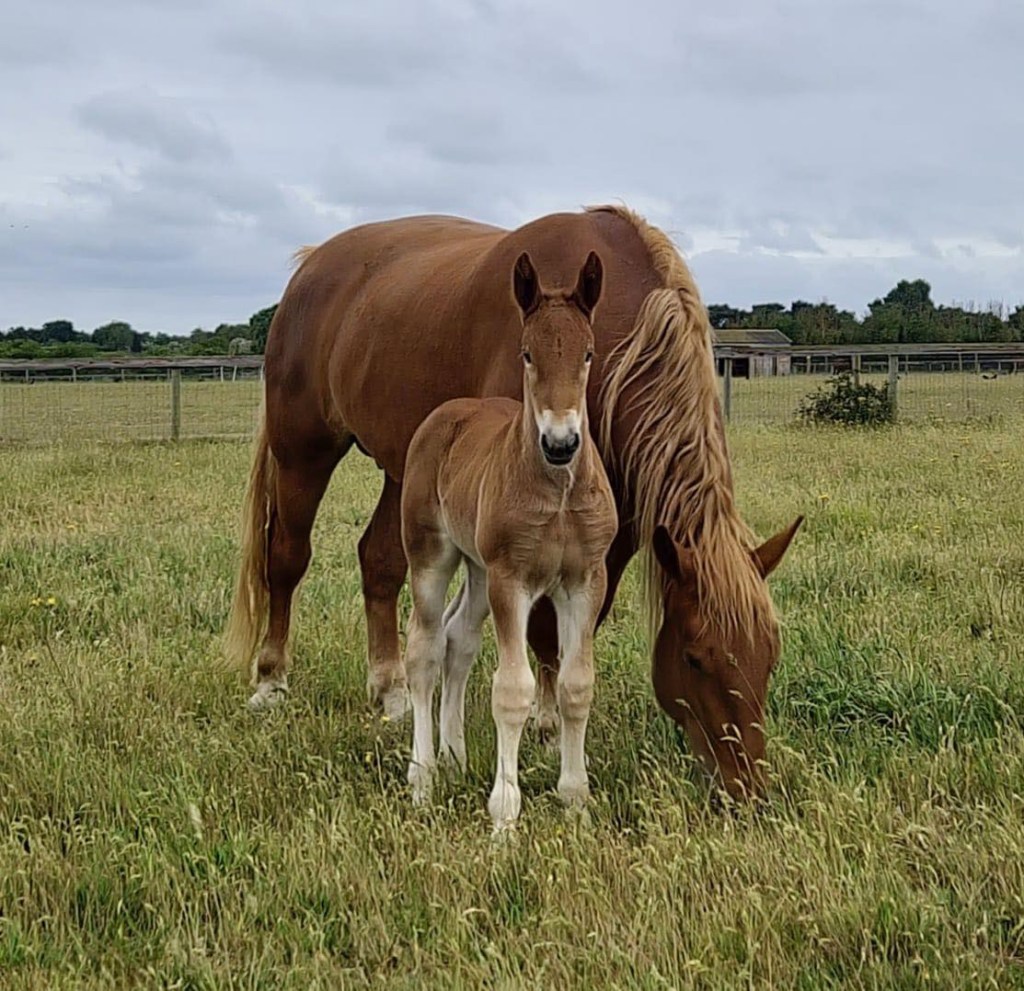
Edith and Lainey
 Sleuthing Notes
An interesting read and a beautiful photo. Thanks for sharing!
LikeLike