Wantisden is a tiny rural parish in Suffolk, which lies mid-way between Woodbridge and Orford in open countryside that still feels isolated today. For more than 100 years, my ancestors called it home – in 1851, there were just 78 inhabitants living in 23 houses, and remarkably they include three sets of my maternal 3x great grandparents: Thomas Page & Mary Ann Bolley, James Fisher & Charlotte Read, and Samuel Cullingford & Hannah Downing.
If there was ever a village in the Parish, any trace of it is long gone as in surviving records the inhabitants all lived in cottages on one of the three large farms where they worked. The 1851 census provides some useful details of them:
- Wantisden Hall – Jonathan Keer was the occupier of 999 acres, employing 20 labourers. The farm was taken over by the Lewin family later that year, who remained the tenants until 1896. The landowner was Nathaniel Clarke Barnardiston.
- Drydale Bottom – John Cockerill was the farmer of 600 acres, employing 20 labourers. The farm was then occupied by William Woolton Flatt from 1866 until around 1897. The landowner was Lord Rendlesham.
- Walnut Tree Farm – Samuel Cross farmed its 450 acres, employing 16 labourers, until Robert Paxman took on the tenancy in 1853 . After 1868, it appears to have been absorbed into the Wantisden Hall estate. It was also part of the Rendlesham estate.
Ordnance survey maps from the late 19th century show that much of the parish was heathland, with farms and cottages accessed via a network of criss-crossing tracks – there was no road through the parish until the early 20th century. In 1868, the Ipswich Journal eloquently described this countryside in an article about the nearby village of Butley:
“For miles around the village there are broad stretches of heath land, the only growth of which is short, fine grass and furze. The grass is said to be much better than it looks for feeding purposes, and acres upon acres of it have been nibbled so closely as to have all the closely-shaven appearance and the delightful elasticity to the tread of a lawn. The cultivated land, which lies in broad patches, looks at certain seasons almost sterile compared with the beautiful green turf and the brightly blossoming furze, so loose and sandy is its appearance”.
The General View of Agriculture, compiled by Arthur Young in 1804, describes a farming system based on a rotation of arable crops (mostly barley) and sheep, which were reared for mutton and fed on turnips in the fields where they had been grown. Newspaper reports of harvests, farm sales and livestock shows suggest that this pattern remained in operation throughout the 19th Century.
Wantisden appears to have been remarkably stable with prosperous tenant farmers and landowners providing long-term employment and housing for the same families across multiple generations.
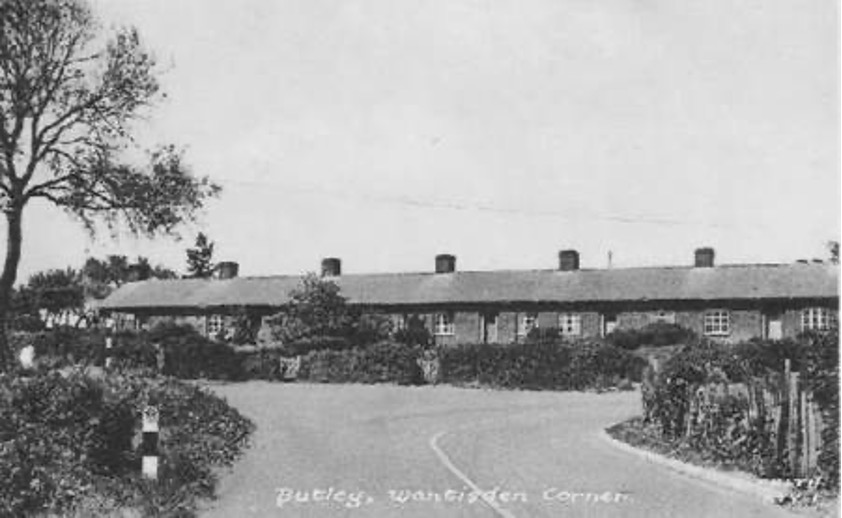
Postcard of Wantisden Corner, date unknown
Most census returns for Wantisden do not identify individual addresses, but the 1861 census does, and this reveals that several members of my family were living in the row of six modest, brick-built cottages at Wantisden Corner, which are pictured above:
- Thomas Page and Mary Ann Bolley, my 3x great grandparents, with their son William Page, my great great grandfather;
- James Fisher, my 3x great grandfather, a widower living with his daughter, Mary Fisher, who would become my great great grandmother when she married William Page, son of neighbours Thomas Page and Mary Ann Bolley;
- William, George and James Cullingford, brothers of my great great grandfather, Samuel Cullingford; and
- John Fisher, son of James.
From their position relative to the Pages and Fishers in earlier census returns, it appears that my third set of 3x great grandparents, Samuel Cullingford and Hannah Downing, are likely to have been living alongside them at Wantisden Corner in 1841 and 1851.
After 1861:
- Thomas Page and Mary Ann Bolley remained residents until 1871, after which they were succeeded by son William Page and his wife, Mary Fisher (my great great grandparents), who lived at Wantisden Corner until William took on the tenancy of Valley Farm, Butley in the late 1890s.
- James Fisher is also last recorded at the cottages in 1871, whilst his son, John Fisher, continued living there until 1881. John’s own son, Henry Fisher is also listed in 1891 and 1901, and other Fisher’s include John’s brother, Samuel (1881) and a nephew, Arthur (1891).
- Brothers George and James Cullingford both lived at Wantisden Corner for the rest of their lives, dying in 1895 and 1903 respectively.
Comparing the clusters of family names that recur across the census returns from 1841 – 1939, it seems that this little community was remarkably close knit, with cottage tenancies passed from fathers to sons. In addition to the extended families of my ancestors, there are several other long term residents: Benjamin Howard (1841 – 1871), James Aldridge (1851 – 1891), Henry Reeve (1901 – 1939) and John Pettit (1901 – 1939).
In 1890, the circle of complex relationships between the Wantisden Corner neighbours was completed when my great grandfather, Samuel Cullingford (grandson of Samuel Cullingford and Hannah Downing), married Esther Page (granddaughter of both Thomas Page and James Fisher). In 1901, Samuel and Esther are themselves living at Wantisden Corner, which they continued to do for the remainder of their lives – Esther’s death in 1946, marked the end of my family’s long association with Wantisden Corner after more than 100 years.
All of the residents of Wantisden Corner between 1841 – 1939 were agricultural workers, including labourers, gamekeepers, warreners and horsemen. In the 1845 Tithe Map schedule, the cottages are on land occupied by the tenant of Wantisden Hall, which is where inhabitants were still working at the time of the 1921 census. I cannot find any evidence that the six dwellings have ever been sold on the open market, suggesting that they remain tied cottages. The distinctive row of houses remains remarkably unchanged today, although it appears that two have now been knocked into one, perhaps unsurprisingly as the census records reveal that they originally each had just 3 rooms.
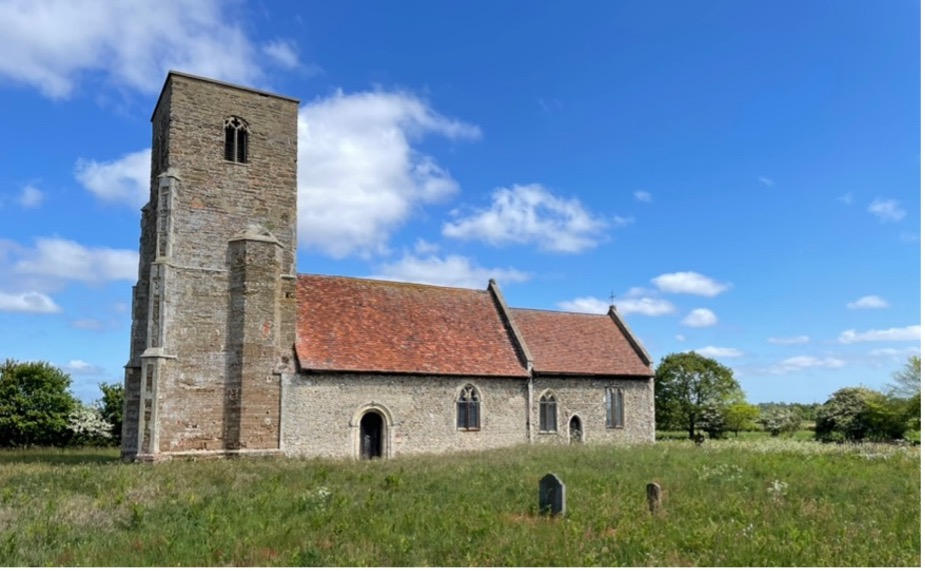
St John the Baptist Church, Wantisden
Of equal significance in the story of the Cullingfords, Pages and Fishers is St John the Baptist Church, which has stood in its isolated position, surrounded by fields, for almost a thousand years. There are numerous birth, marriage and burial records relating to my ancestors in the Parish Register, amongst the last being the baptism of my grandfather, William Jack Cullingford, who was born at Wantisden Corner in 1899.
During WWII the church was almost lost as the original plans for the construction of RAF Bentwaters would have seen it demolished. Family legend has it that the building was saved when Muriel Cullingford, wife of my Great Uncle George, went to the Houses of Parliament with the vicar to lobby their local MP. The plans were adjusted, and the church was saved, although George and Muriel were to lose their home at Bentwaters Cottage, the remains of which now lie somewhere under the main runway.
 Sleuthing Notes