This week’s post could easily have been very short as I have never heard a single member of my family playing a musical instrument ! I know that my mother and my aunt had piano lessons when they were children, and my grandmother’s sister, Ada Howe, played the violin in an orchestra in Winchester, but the musical gene clearly doesn’t run deep in my DNA.
Fortunately, lurking amongst the many hundreds of census records relating to my ancestors, there is one man who lists his occupation as a musician – Amos Cullingford, who states that he was a professional violinist in 1891.

Extract from the 1891 census for Wantisden, Suffolk
Amos is visiting his parents, William Cullingford and Mary Matten, on the farm where they worked in Wantisden, Suffolk – he was the youngest of their four children and was born in the Parish in 1865. His father was the brother of my great great grandfather, Samuel Cullingford, which makes Amos my 1st cousin 3x removed.
An admission register from the Strand Union Workhouse dated 1892 provides a clue to where Amos played his violin since it covered the area of the West End of London famous for its theatres and music halls, all of which would have had an orchestra. At this time, workhouses were not just a refuge for the poor but also provided medical treatment for the general population as the forerunners of modern hospitals – the record reveals that this was the case for Amos, who was admitted to the Sheffield Street Casual Wards on 24 June and discharged on 9 July “to friends”.
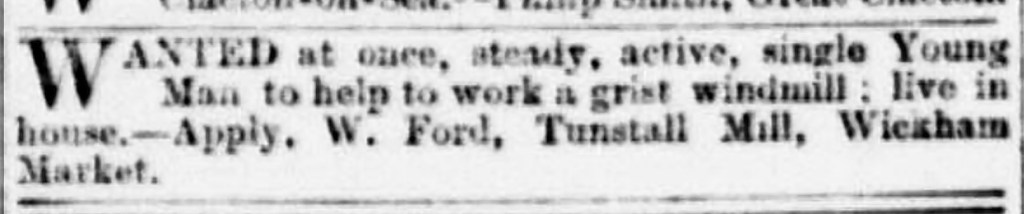
Sadly, Amos’ musical career appears to have been short lived as by 1901 he had moved back to Suffolk, taking up residence in a hamlet named The Common, Tunstall which lies just two miles from Walnut Tree Farm, where his parents worked. In 1901 and 1911, he is working for a miller as a carter, which would have involved him collecting grain from local farms in a horse-drawn wagon and delivering sacks of flour to customers. Could he have responded to this advertisement posted in the Suffolk Mercury on 25 December 1896 ? He is certainly living with William Ford and his wife at the Mill House when the census was taken.
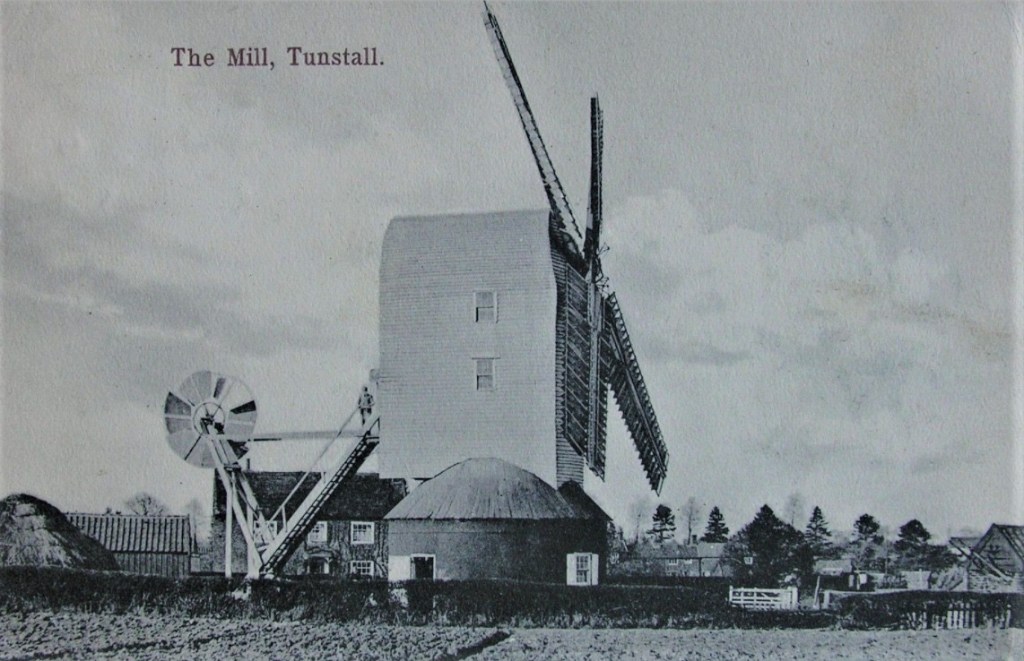
Tunstall Mill was a post mill, which means that the entire structure could be turned to face the wind. Built around 1813, it was one of the largest in the county until it was demolished in 1929 when steam powered mills rendered it obsolete.
In addition to his work at the mill, Amos appears to have had an entrepreneurial streak as in 1911 he states that he is also a part-time watch and clock repairer. I cannot find anyone in the district who he might have worked for, and in any case he was much too old to serve an apprenticeship, so it seems likely that he was self-taught. This would not have been unusual for the time and no doubt his experience of working with the gears that drove the millstones would have come in useful.
By 1921, he is no longer working for the miller but splits his time between repairing clocks at home and acting as an auxiliary postman. Auxiliary postmen worked part-time, generally for fewer than 3 hours a day. They were issued with a uniform but received lower pay and fewer benefits than full-time post office staff. The closest Post Office was in Tunstall village, half a mile from The Common, and an extract from Kelly’s Directory of Suffolk, dated 1912, gives an idea of Amos’ likely pattern of work:
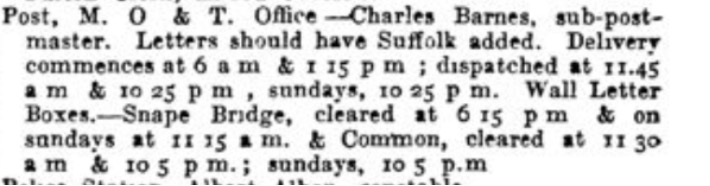
Extract from entry for Tunstall in Kelly’s Directory of Suffolk, 1912
The Post Office at Tunstall employed several postmen, and amongst them was another of my 1st cousins 3x removed – Frederick Robert Jaye, who was born in Tunstall in 1877 and worked as a postman in the village for 40 years according to a 1941 ill health gratuity record. Frederick was related to Amos through the marriage of my great grandparents – Esther Page was his cousin, and Samuel Cullingford was Amos’ cousin.
By the time of the 1939 register, Amos is no longer working but was clearly very proud of his service with the Post Office as he chooses to describe himself as “auxiliary postman retired”. He never married and lived alone in his cottage at The Common for more than 50 years.
Amos died in Ipswich General Hospital on 25 April 1954, aged 81, leaving £384 12s 6d to be administered by his nephew, Arthur Oscar Read. His occupation is recorded as “retired postman GPO”.
In many ways, his was an ordinary life but, in one respect at least, Amos Cullingford is unique – he is the only man of that name ever recorded in the English birth, marriage or death records and, at the time of writing, the only one listed in Ancestry’s extensive worldwide database.
 Sleuthing Notes