My grandmother’s sister, Christina Clark, was born on 27 March 1865 in Peterhead. She was still living in the town with her mother and siblings at the time of the 1871 census, but by 1881 appears to have left home as she is recorded as an unemployed domestic servant in Aberdeen.
On 5 October 1886, Christina married George Emslie Fowler in Leith. Their marriage was “irregular” – a unique practice legal in Scotland until 1940 whereby, instead of a ceremony conducted by a church minister, the couple simply made a declaration in front of two witnesses, who in this case appear to have been George’s siblings, Thomas and Elizabeth.
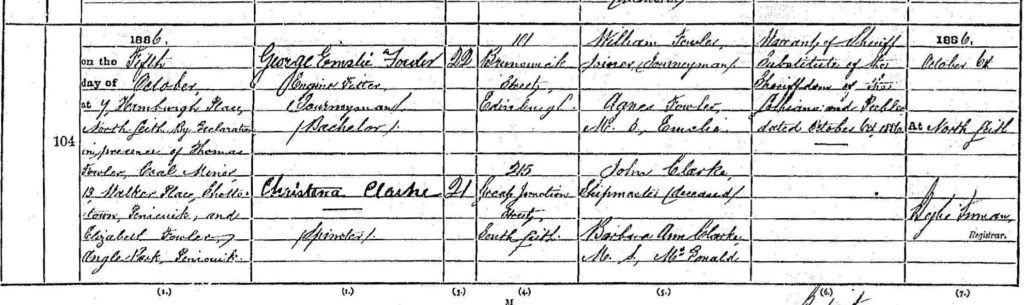
Marriage record for Christina Clark and George Emslie Fowler, 1886
[Source: National Records of Scotland]
In addition to the unusual form of marriage, which is the only example I have come across in my tree, there are some other interesting anomalies in the registration – firstly the spelling of her surname as Clarke, but more interestingly the fact that her father, John Clark, is described as a deceased shipmaster when he was very much still alive and had never described himself as anything other than a seaman. Were these simply errors made by whoever registered the marriage or was Christina attempting to mask her identity ?
The couple emigrated to Victoria, Australia soon afterwards and their first son, William, was born there on 24 April 1887 so it appears that Christina was already pregnant when the marriage took place. A second son, Albert George, was born on 1 May 1890, but the Fowler’s marriage seems to have been a disaster according to a series of Australian newspaper reports.
In December 1890, George petitioned to divorce Christina on the grounds of adultery with Daniel Stewart, who was a lodger in their home. A report in the Argus newspaper provides some intriguing details: Christina was apparently working as a waitress in a Leith restaurant when she met her husband and he claims that a week after their marriage she was charged with robbery when stolen goods were discovered in their home. Owing to the fact that they were newly married, the victims decided not to proceed with a prosecution but George asserts that there had since been many violent quarrels with his wife as she was “a confirmed kleptomaniac”.
In support of his case, George claimed to have found his wife in a compromising position with their lodger when returning home unexpectedly early one day and it is also reported that he admitted the paternity of just one of his sons, presumably the youngest. Despite the evidence of a large number of witnesses on either side, the Judge was of the opinion that the evidence did not infer that adultery had been committed and the petition was dismissed.
This was far from the end of Christina’s legal troubles, however, as in March 1896 she was convicted of stealing the luggage of the Benson sisters who had missed the departure of a coastal steamer from Sydney to Melbourne that she was also traveling on. A melodramatic and rather smug newspaper article by one of the detectives involved in her arrest tells us that Christina was “about the last person in the world one would take for a habitual thief. She was tall, slight, under middle-age, good looking, neat, smart and well-spoken”. Her husband, who was an engineer, is described as “a decent fellow who could not live with her on account of her thieving propensities” and as Christina had been travelling under the name of Miss Clark, they appear to have been separated at the time. Due to a previous conviction, involving theft at the Metropole Hotel in Sydney in 1892, Christina was jailed for 14 days.
Three months later, she was back in court, this time summoning her husband for maintenance on the grounds that he had left her without means of support – poor George was ordered to pay her 12s 6d a week.
This is the last trace of my great aunt that I have been able to find.
In an 1897 Glasgow Poor Relief application made by her father, John Clark, Christina is correctly described as married with two children, but there is a question mark where her husband’s name should be and her location is given as South Africa, suggesting that she was not in close contact with her birth family at the time. As my grandmother was not born until 3 years after the Fowlers emigrated to Australia it is highly unlikely that she ever met her sister.
In 1924, eldest son William Fowler named his daughter Christina, but an obituary notice for George Emslie Fowler in 1929 makes no mention of a wife, describing him simply as “the loving father of William and Bert”.

