I have previously written about the surprising discovery that my great grandfather, Samuel Cullingford, was working as a maltster in Burton-on-Trent in 1891, 150 miles from his Suffolk home, but in 1881 he was actually even further away as he appears in the records listing vessels in Penzance harbour.
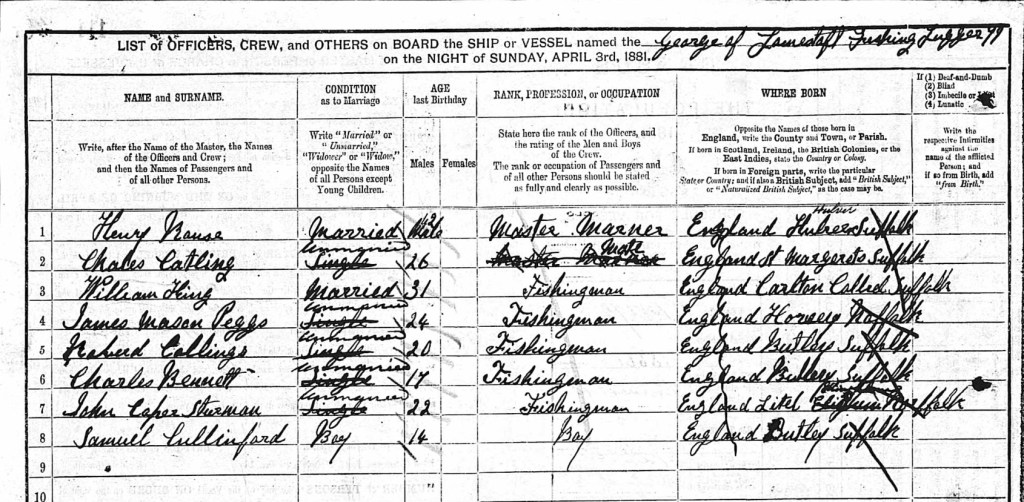
Samuel, aged 14, is one of 8 crewmen aboard the George, which the census schedule reveals was a lugger, registered in Lowestoft as LT79. Luggers were widely used as working craft off the coasts of the UK and France and were named for their use of lug sails, which allow for simple and versatile boat handling in coastal wind conditions.
Lowestoft records reveal that the George was built in 1855 in Yarmouth and describe it as a drifter, which is a type of fishing boat designed primarily to catch herring in a long net hung like a curtain from buoys. Once the net was out, the boat would simply drift with the tide trapping fish in the mesh. The George would have looked similar to the boat in the image below – the lug sails are the four-cornered ones overlapping the top of the masts.
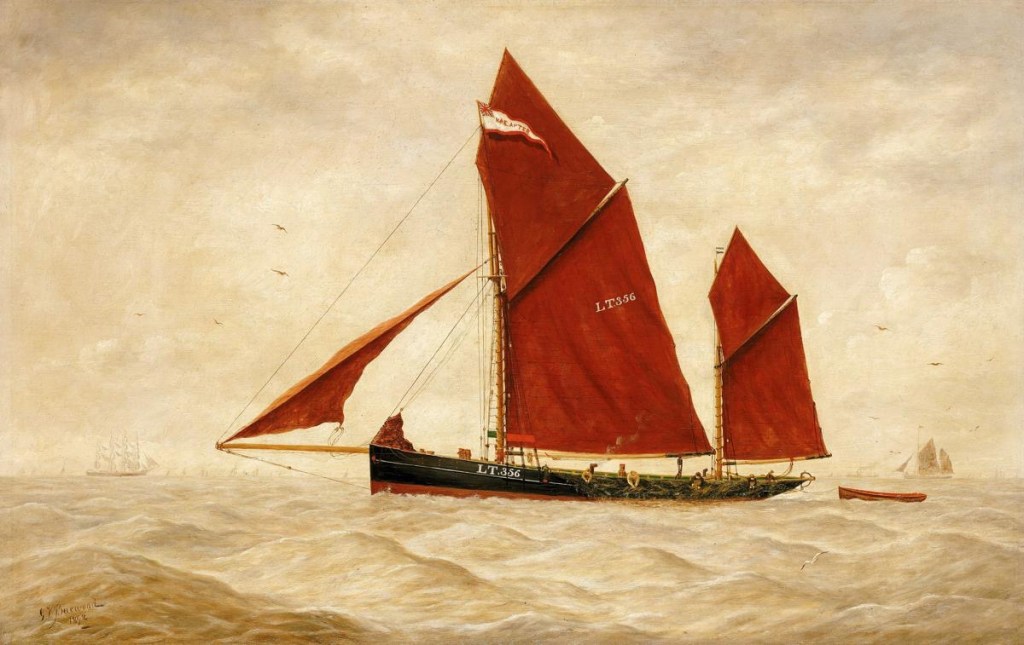
The Lowestoft Trawler by George Vemply Burwood, 1892
Herring fishing has a long history in Britain and had become a vast industry by the late 19th century when thousands of boats were working along the east coast, catching the fish that were cured, packed in barrels and sent to the lucrative markets of eastern Europe, where they were considered a great delicacy. The activity was seasonal, with boats following the shoals of fish as they migrated south from Scottish waters between June and October.
So, what was the George doing in Penzance in April when the census was taken ? The answer is provided in the enumerator’s title page – mackerel fishing, which often served as a springtime occupation for fishermen as they awaited the herring season. Mackerel are also migratory and in the early part of the year form huge shoals in coastal waters as they move towards their spawning grounds, making them the ideal catch for boats that would otherwise lie idle.
It is likely that once the herring season began a few weeks later, the George would have been amongst the many drifters that followed the fish up through the Irish sea before being manually towed 35 miles through the Forth and Clyde canal to join the run back down the east coast to Lowestoft.
A rising population and the agricultural revolution meant that it was common for young men from rural communities to seek such work in the second half of the 19th century, and perhaps the more remarkable thing is not Samuel Cullingford’s travels but that most of my Suffolk ancestors remained working on the land well into the 20th century.
The 1881 census reveals that two other young men from Butley were aboard the George – Charles Bennett and Robert Collings. Charles was born in 1864 and was the son of Thomas and Emma Bennett who were close neighbours of the Cullingfords in The Street, Butley – like Samuel, he eventually returned to work on a farm, becoming a shepherd by the time of the 1891 census.
Robert Collings, who was born in 1860, proved a little harder to trace, not least because it looks like his surname was actually Collins – his father, John, was an agricultural labourer and in 1871 the family were living in Mill Road, Butley so again they would have been well known to the Cullingford family. I can find no trace of Robert in the 1891 or 1901 census, suggesting that perhaps he remained a fisherman for many years, but he was married in Butley in 1903, and after that he is recorded as a farm labourer.
It is impossible to know how many voyages my great grandfather made round Britain aboard a fishing boat, but the 1881 census raises an intriguing possibility – after crossing Scotland and reaching the north sea, the herring boats often sailed northwards to join the large fleets operating out of Peterhead and Fraserburgh, which makes me wonder whether, against all the odds, my Suffolk great grandfather might actually have been in the towns where my Aberdeenshire ancestors were living.

